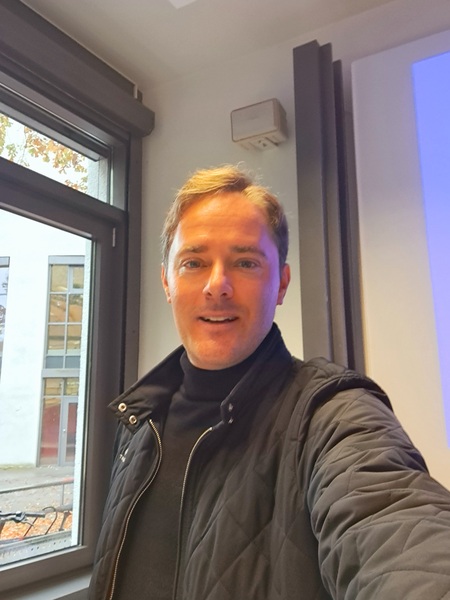
Martin Schwarz provides insights into how he went from being a trainee to a vocational educator, which moments in his life were significant for him, how he finds balance through running and nature, and how his monograph “Pädagogik im Betrieb” came about.
Find out what challenges he faces as part of the InnoVET PLUS joint project and what tips he gives students on how to write their own texts.
1. what moment in your life sparked your passion for vocational and company education?
Dr. habil. Martin Schwarz - Academic Senior Councillor, Professor
for Vocational Education & Project Manager InnoVET PLUS
Looking back, the foundation stone was laid in the context of or at the end of my dual vocational training at the time. It quickly became clear to me that I didn't want to work in a specialist area. I was much more interested in in-company training and further education. So I initially became a company trainer and completed the training of trainers - the AdA certificate for short - as my first rudimentary vocational training qualification through the Chamber of Industry and Commerce. But it didn't stop there...
Later, or rather quite soon, I left the company and studied vocational and company pedagogy, at that time still as a diploma course. This was followed by professional positions as a personnel developer and project manager in a consultancy firm for in-company training. I completed my doctorate as part of the research training group 'Change processes in industry and service professions' at Martin Luther University Halle-Wittenberg. This is where my interests in occupational research, the professionalization of pedagogical forms of action, in particular counselling and continuing education research, were awakened. I almost went to the BIBB (Federal Institute for Vocational Education and Training), where I had already signed up, but then almost at the same time I had the opportunity to take up an academic council position at my home university, the RPTU Kaiserslautern-Landau. I had later completed my habilitation there with a research paper on continuing vocational training, which in a way closed the circle. At the RPTU, I then added the topics of school pedagogy, teacher professionalism and school development, which address the school as a place of learning in vocational education.
I also consider my time in Saarbrücken to be a very significant moment. Here I was able to spend three years helping to set up a university and develop vocational education. I was on leave from RPTU for this time. The decisive factor here was that the students were the same age or older than me and, as already established teachers - in schools for healthcare professions - they needed post-qualification in vocational education. On the one hand, it was important to do justice to adult learning and, on the other, to bring the standards of social and educational science and vocational education closer to the students and create a professional working alliance.
My credo is "Know what you can do, know what you know". On the one hand, (one's own) knowledge inevitably includes (one's own) non-knowledge, which one has to continuously work on verifying and becoming aware of. This helps us to approach things and objects with humility and curiosity. On the other hand, the sentence emphasizes the bridge between theoretical knowledge and practical ability, which also corresponds to the understanding of expertise. In retrospect, I can say that I have gone through all stages of vocational training, which I personally perceive as the greatest enrichment for my current role in vocational education and at KIT.
2. how did your most important publications in the field of vocational/vocational education and continuing vocational training come about? What was your personal motivation for doing this research and what tips do you have for students who want to write their first scientific articles?
On the question of the most important publication, I would of course include the monograph as part of the habilitation process. The study"Pädagogik im Betrieb" (Pedagogy in the workplace) has resulted in a large number of individual articles.
On the one hand (Part One), the theoretical perspectives on pedagogy in the workplace are analyzed: These can be characterized on the one hand by different disciplinary approaches (e.g. business administration, sociology) and on the other hand by a variety of social and educational science reconstructions and pedagogical legitimations (e.g. through adult education, vocational education, adult pedagogical organizational research). Here, the perspectives of theory formation are systematically reconstructed and examined for their usefulness in determining the object of practice in the institutional context of the company.
On the other hand (part two), an empirical analysis necessary for the definition of the subject is carried out, which reveals the appearance of the forms of action of pedagogy in the workplace in a differentiated way. This appearance is constituted in a highly organization-specific manner and thus does not represent a monolithic entity. Rather, the task-specific design is the result of complex negotiation processes between the actors involved in the institutional context of the organization. In other words, it does not follow premises that originate from other reference areas, such as education policy, science and the public, but rather shows a recontextualization on several levels in the logic and (action) conditions of the organization.
With regard to the question of drive and motivation, this can be traced back to a disproportion and an experienced discomfort: Corporate training/personnel development, or designations such as people and culture management or human resource development, is highly relevant and represents a prominent area in which, to a certain extent, pedagogy finds expression. It is also an important labor market for educators. This is impressively demonstrated by data from continuing education reporting. However, this area has received little theoretical reflection and even less empirical analysis.
On the question of tips: A sentence by Samuel Backet comes to mind here: "Ever tried. Ever failed. No matter. Try again. Fail again. Fail better". Failure is part of the process and part of the journey! Children learn from their failures when they assemble and explore something. I was able to observe this often enough with my own children. Unfortunately, failure has negative connotations in our society and is almost taboo. For the writing process, this means simply trying (better) again and again instead of being discouraged by supposed failure and the opinions of others.
3. you are currently responsible for a third-party funded project.Could you briefly explain what it is and what its core objective or content is?
Our project is part of InnoVET PLUS, a central measure of the Vocational Education and Training Excellence Initiative of the Federal Ministry of Education (BMBFSFJ) with a volume of around 60 million euros. The initiative is funding 28 projects over almost four years with the aim of shaping the transformation, attracting skilled workers and strengthening vocational training.
Our InnoVET PLUS project "Lernfabriken@BeruflicheBildung" is developing and testing alternative forms of operation (so-called operator models) for vocational learning factories with specific further training offers. So far, vocational learning factories have only been operated by specific vocational schools, which makes it difficult to use them in and for the context of continuing education. The project also establishes links with existing continuing education platforms and creates networks for the transfer of vocational learning factory offers for continuing education in small and medium-sized enterprises (SMEs). Furthermore, a university certificate "Learning Factories for Vocational Education and Training" will be developed, established and tested during the course of the project. In order to achieve our goals, we are working together in a powerful network, which includes the TU Hamburg, the ZfW of the IHK Heilbronn-Franken, the Nachwuchsstiftung Maschinenbau, the AgenturQ, the RPTU Kaiserslautern-Landau and the KIT.
4. what specific challenges in today's vocational training does your InnoVET PLUS project address and what solutions does it focus on?
One or the biggest challenge in our project is the lever of further training through cooperation. Through education policy postulates such as the National Continuing Education Strategy (NWS), continuing education is inevitably becoming a key variable for social, economic and individual development. However, the InnoVET PLUS project is essentially concerned with how vocational learning factories can be developed for continuing education.
The continuing education system in Germany is specific. For example, a study by the OECD, which examines continuing education and training internationally and comparatively, noted that Germany has a very complex system of continuing education compared to other OECD countries, which is strongly characterized by self-responsibility and organization, decentralization, plurality of institutional providers and education federalism as a specific feature in terms of governance structures of control, provision of funding and planning (see OECD 2021, p. 4).
In other words, on the one hand, this structural feature is a great strength, as the continuing education offer can respond to the different requirements of individuals, organizations and regional labor markets. On the other hand, however, it is also a weakness, as it brings with it coordination and cooperation challenges. This is accompanied by the need to develop a culture of cooperation across different interests and multiple logics of action, which can contribute to strengthening the effectiveness of the continuing education system.
5. which hobby or leisure activity provides you with the necessary balance?
My source of balance and regeneration is running. I like to run alone, but also regularly with a long-time friend and regular running partner. Running is also an inspiration for me. On the one hand, it allows me to let go, and on the other, I often get good ideas for my work while running. I run without music. The nice thing is that you can hear the snow under your shoes in winter (at the moment!) and the birds singing in summer.
We have also started several times, for example at the Baden Marathon and the Bienwald Marathon in the half-marathon category with groups of vocational education runners in different compositions.
Would you like to find out more about the topics covered by Mr. Martin Schwarz?