
Interdisciplinary learning space: Pedagogy meets Industry 4.0 in the KIT Learning Factory
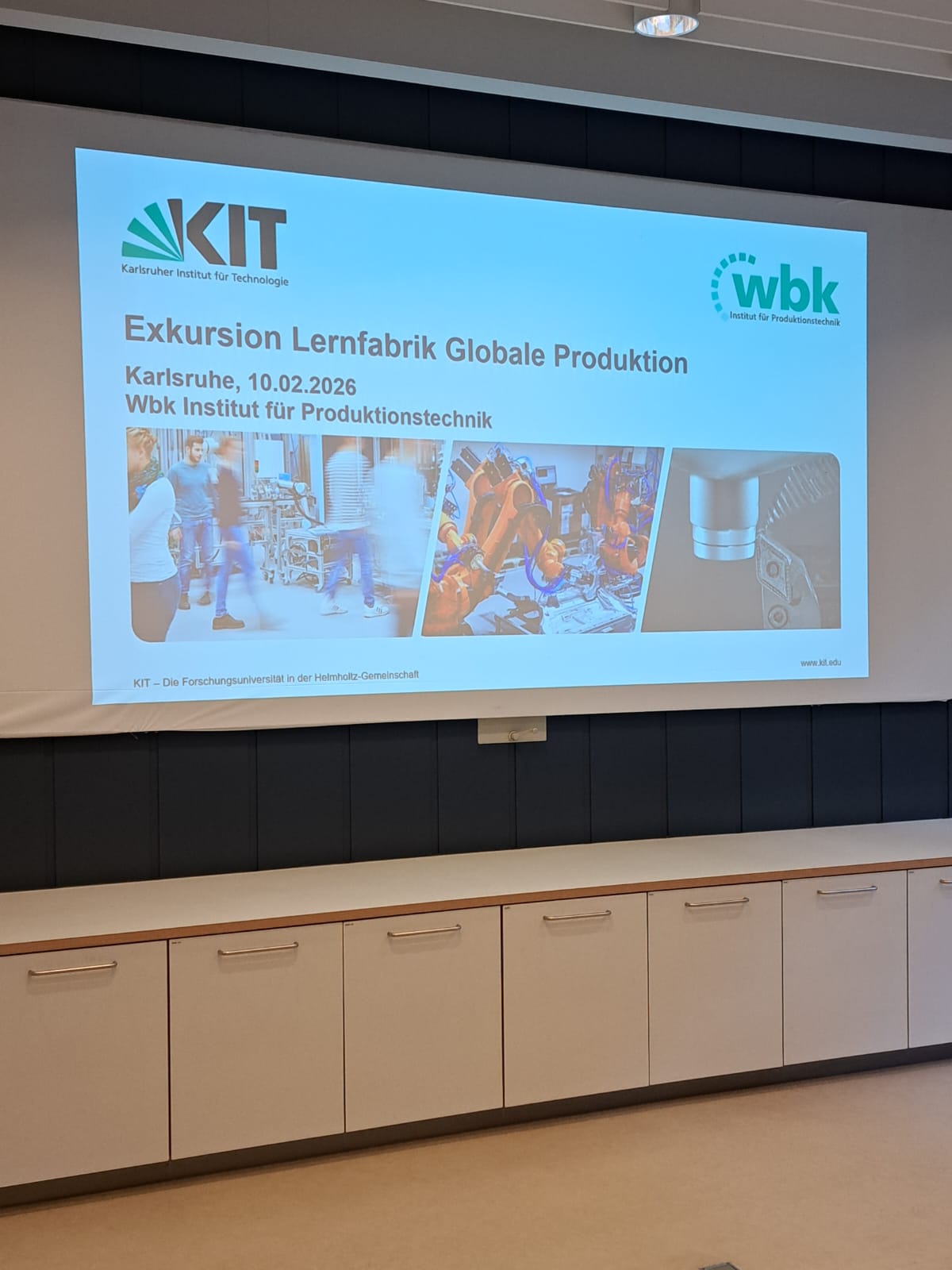
At the end of the seminar "Current Topics in the Sociology of Work and Industry" (WS 2025/26), the seminar group of Master's students of education visited KIT's own learning factory "Global Production" at the wbk Institute of Production Engineering together with the scientific staff of the Department of Vocational Education of the Institute of Vocational Education and General Education. The learning factory authentically reproduces industrial production processes as a realistic, changeable value chain. By systematically interlinking modern automation and production control systems with mechanical engineering, electrical engineering and information technology, central elements of Industry 4.0 can be experienced in a practical way. At the same time, the wbk combines current production technology research with teaching and further education in this environment.
The direct encounter with a technical production environment offers particular added value for students of education: it provides an in-depth insight into the real working contexts for which vocational training prepares students. The dovetailing of production technology and vocational education opens up the opportunity not only to understand industrial processes functionally, but also to reflect on them from the perspective of professional and educational theory. This creates an interdisciplinary learning space in which technical expertise and educational science perspectives are systematically linked.
Following the seminar content on the sociology of work and industry, the learning factory was analyzed on site as a socio-technical and cyber-physical working and learning system. Three perspectives structured the observation: the human role in the production system with its tasks, responsibilities and competence requirements; technology as an orientation aid that structures action and frames decisions; and the didactic potential of the changeable production environment, which can promote a deeper understanding of digitalized work processes beyond mere adaptation training.
In the future, both institutes will strive to continue exploring synergies and to more closely link technical and pedagogical perspectives in research and teaching - a development that is productively supported by joint formats of this kind.